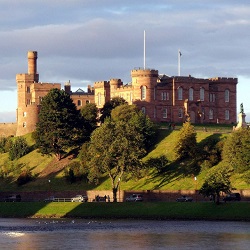
Inverness
Photo © Robin Canfield

More details
Inverness is a city in the Scottish Highlands in the north of Scotland. Long regarded as the de facto capital of the Scottish Highlands, it is the administrative centre for The Highland Council region whose headquarters are located close to the city centre. A regional hub for healthcare, education and research, business and economic services, public administration, culture, music and entertainment, media, communications, transport and leisure, the city provides a range of services for the wider Highlands and Islands Region, a large hinterland encompassing a population of around half a million people and an area of some 39,911 km² or 51% of Scotland's total landmass.
Inverness previously served as the county town of the county of Inverness-shire before becoming the headquarters of the larger Highland Council region. With human settlement dating back to circa 7000 BC and permanent human settlement established by 5,800 BC the city has remained a strategically important location since antiquity and has periodically experienced armed conflict. Today, Inverness lies near two important battle sites: the 11th-century battle of Blàr nam Fèinne against Norway which took place on the Aird and the 18th century Battle of Culloden which took place on Culloden Moor, the last pitched battle fought in the United Kingdom. Lying within the Great Glen (An Gleann Mòr) at its northern extremity, the city's River Ness flows from Loch Ness via Loch Dochfour before it empties into the Moray Firth where the historic Beauly Firth and Inverness Firth met at the Kessock Crossing. The northernmost city in the United Kingdom, it was granted city status in the year 2000 as a Millennium City, having become more prominent in its economic and population growth throughout the preceding decade.
Following the early settlement of Inverness, the city became an established self-governing settlement by the 6th century with the first Royal Charter being granted by Daibhidh I mac Mhaoil Chaluim (King David I) around the year of 1160. Inverness and the surrounding country are closely linked to various influential clans, including the locally powerful Clan Mackintosh, Clan Fraser and Clan MacKenzie. Local clans unique to the city include Donnchaidh (Robertson) of Inshes, MacSheòrais (Cuthbert) of Castlehill, MacLean of Dochgarroch, Fraser of Culduthel and Leys, Baillie of Dunain, Shaw of Essich, and Forbes of Culloden.
Between 2001 and 2022, the population of the old urban core of Inverness west of the A9 (historically Rathad Mòr an Rìgh or the King's Great Highway), grew from 40,969 to 48,248. The Greater Inverness area, including areas not previously connected to the rest of Inverness, including Culloden, Balloch, Resaurie, Smithton and Westhill had a population of 56,969 in 2012. Four years later, the population had grown by 6351 to 63,320, an increase of 10%. Inverness is one of Europe's fastest growing cities, with over a quarter of the Highland population living within the city or in its surrounding areas. Recent planning decisions by the Highland Council have approved the construction of housing developments near Inshes which will establish an area of continuous urban land with the potential to provide clarity and continuity for the city's population and growth in the years ahead.
Inverness is noted for its high quality of life and the happiness rankings of its population, frequently ranking high for its quality of life and levels of happiness among its residents. In 2008, Inverness was ranked fifth out of 189 British cities for its quality of life, the highest of any Scottish city. The city was ranked the happiest place to live in Scotland in 2014 and 2015, 5th in terms of quality of life in 2015 repeating its 2008 place as the highest quality of life in Scotland, the second happiest place in 2023 and in 2024, the happiest place to live in the entire United Kingdom.
Source: wikipedia
Address: Inverness, IV1 1AN, United Kingdom
Categories: Populated placePopulated place - city